
Designing an Estate-Scale Lighting System: A Great Falls Case Study
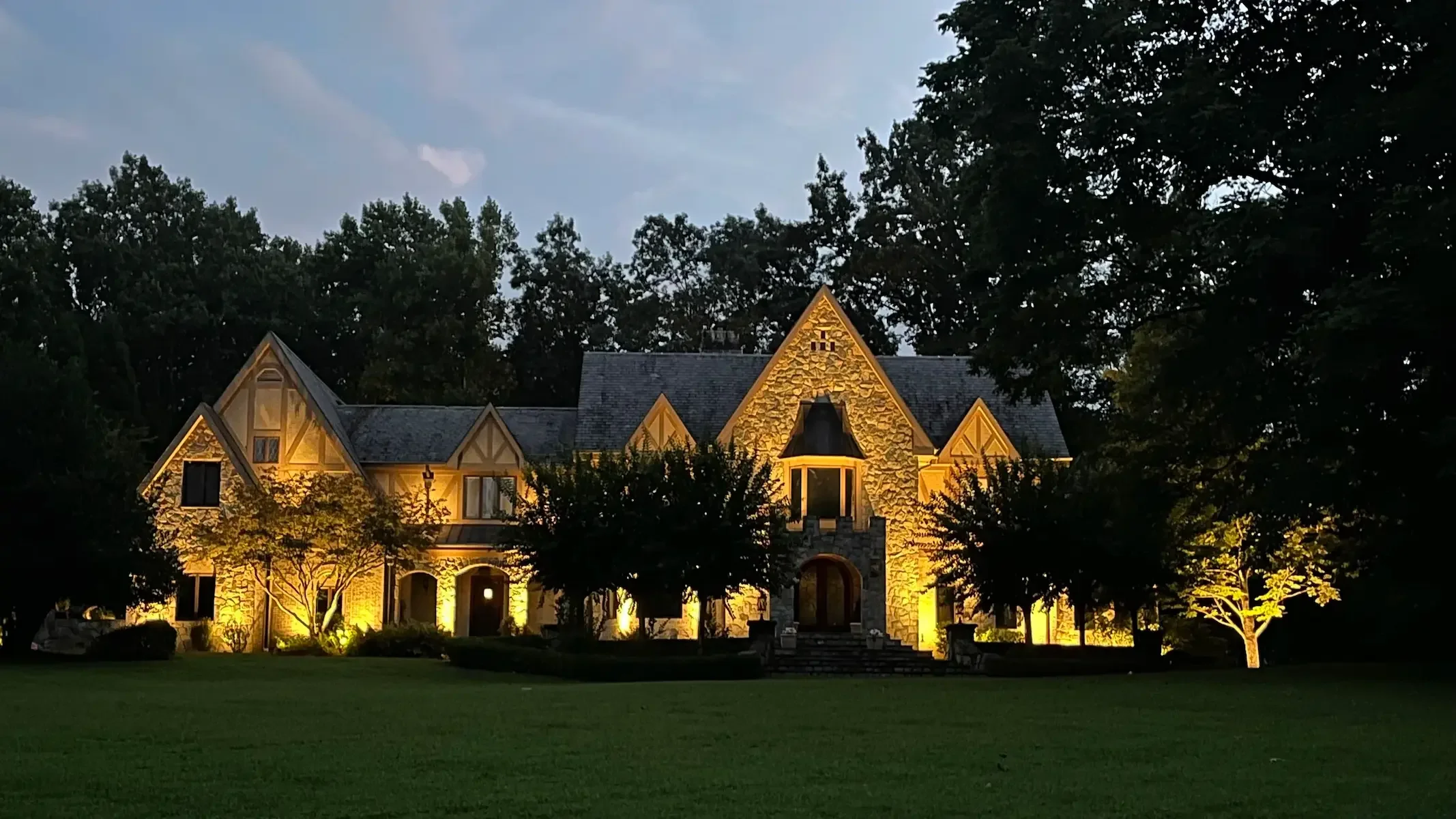
The completed architectural lighting design restores depth, balance, and presence to this Great Falls estate’s stone façade.
When this Great Falls homeowner first reached out to Loudoun Lighting, they weren’t looking for a full lighting redesign. They simply wanted a consultation—someone to come out, look at the property, and help them get their outdoor lighting working again.
That request alone told us something important: most homeowners don’t wake up one day and decide they want to overhaul an entire estate-scale lighting system. What they want is functionality, safety, enjoyment, and confidence that their system can be relied upon.
But once we walked the property, it became clear that this wasn’t a “repair and restore” situation. It was an opportunity to rethink how lighting could serve the property—not just today, but for decades to come.
Understanding the Property Before Touching a Fixture
This is a four-acre corner estate in Great Falls with visibility from two public roads. The home itself is roughly 10,000 square feet, a Tudor-style stone residence with a commanding presence. A horseshoe driveway connects both streets, creating a grand arrival sequence. Stone walls, fencing, archways, half-walls, and a castle-like portico reinforce the estate feel.
The property includes:
A pool and outdoor pavilion with a stone fireplace
A Japanese-inspired garden
Extensive sports amenities: sport court, batting cage, basketball half-court
Family-focused outdoor spaces for play and entertaining
Before ever stepping foot on site, we spend time preparing using publicly available county tools to review aerial imagery and take preliminary measurements. This helps us understand scale, setbacks, tree cover, sightlines, and circulation patterns. We do this deliberately so that when we meet with a client on site, we can focus on design priorities and decision-making rather than discovery.
On paper, the property had everything. In reality, the lighting no longer reflected the scale or quality of the estate.
When Repair Isn’t the Responsible Recommendation
As we walked the property with the homeowners, we tested the existing system. What we found was consistent with what we see on many older estate properties:
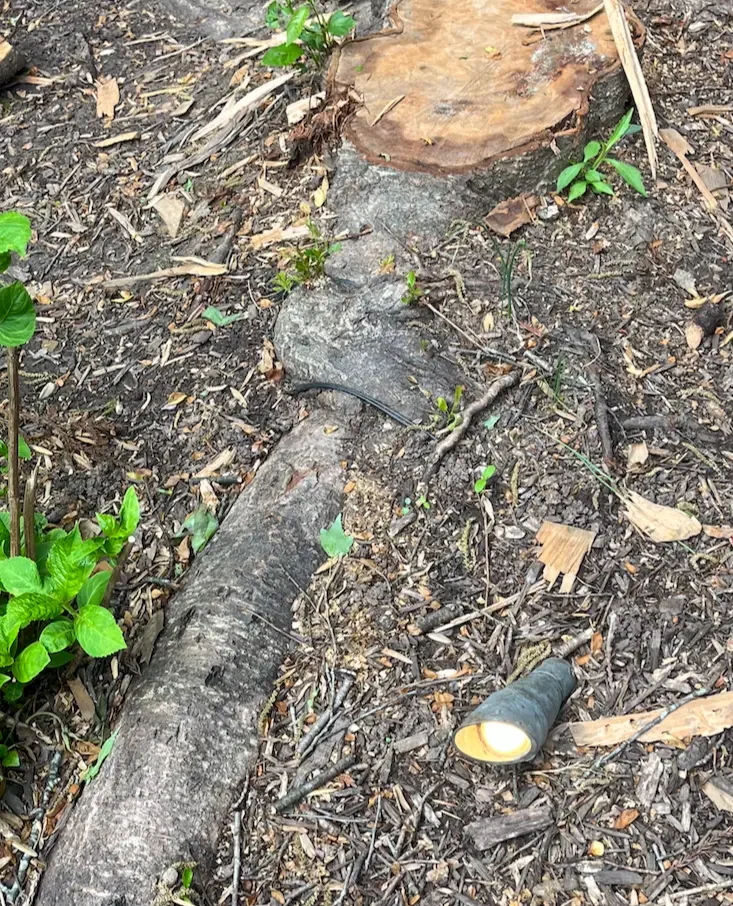
Over time, tree roots lifted and stretched the original underground wiring, causing breaks and rendering most of the system unusable.
Wiring had been lifted out of the ground as trees grew, stretched over exposed roots, and in some cases absorbed directly into the tree itself.
Fixture removal was complicated in cases where they had been mounted to trees that had since grown around them, making removal impossible without damaging the tree or the fixture.
Major wiring had been severed by construction done later, specifically the sport court.
Most fixtures were too deteriorated to safely repair. Removing them from the ground would destroy them. From a professional standpoint, repairing this system would have been irresponsible. It would have meant reusing compromised infrastructure and guaranteeing future failures.
Only a few components, like the transformer and some front-yard fixtures, could be salvaged. The rest required full replacement to ensure long-term reliability.
Sometimes the best solution is a full redesign—not a patchwork repair.
Listening First, Designing Second
Rather than immediately jumping into design solutions, we spent time understanding how the family actually uses the property:
Where do they enter most often? Which driveway approach matters more?
Where do they spend time in the evenings?
Which rooms inside the home look out onto the landscape?
Those questions revealed something important: hile the backyard pool area was central to summer entertaining, the homeowners’ biggest frustration was the front of the home. Despite its architectural beauty, it lacked proper lighting. Retail-grade fixtures had been placed inconsistently, producing heavy shadows and failing to highlight the home’s architectural beauty.
At the same time, the backyard lighting needed a dual purpose: functional use outdoors and visual enjoyment from inside during the long winter months. This principle guided our design.
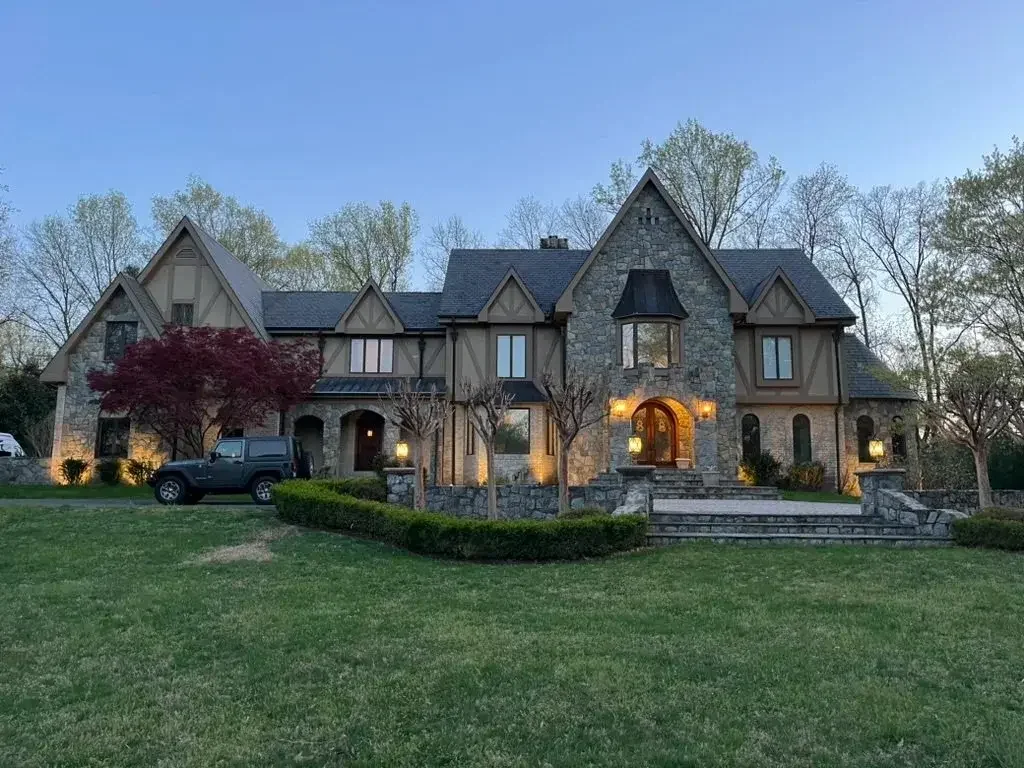
Before: Existing ground-mounted fixtures provided uneven coverage and failed to illuminate the home’s upper architectural elements.
Restoring Architectural Presence at the Front of the Home
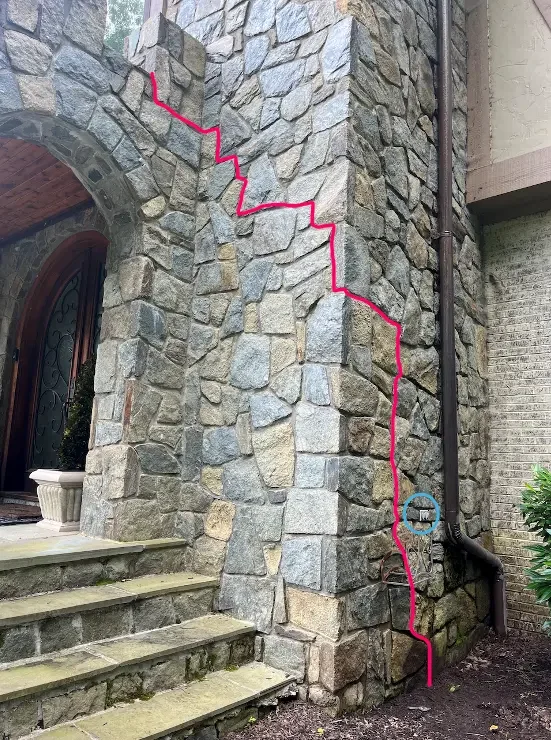
This marked-up façade image shows how wiring was concealed within mortar joints to power portico-mounted fixtures, preserving the integrity and appearance of the home’s stonework.
The front façade required layered lighting to:
Highlight the stonework
Emphasize architectural rhythm
Illuminate up to the roofline
As we walked the homeowners through the design, we used a laser pointer to indicate exactly where fixtures would be mounted and what architectural elements they would illuminate.
Most homeowners don’t speak in terms of soffits, dormers, fascia boards, or porticos. Visual explanation makes the design tangible.
Because the façade is full stone, wiring was concealed in ground-level mortar joints, then re-mortared—a labor-intensive process but necessary for a clean, professional result.
Discussions about warm white vs. color-controlled lighting ensured the system balanced elegance with flexibility for special occasions.
Rebuilding the Backyard as a Destination
Backyard design focused on:
Pool and surrounding pathways
Pavilion and stone fireplace
Tree framing and sport court visual continuity
Around the pool and pathways, the homeowners were drawn to bollard lighting— eight 30-inch black powder-coated fixtures—to provide both functional guidance and sculptural presence.The pavilion features downlighting on columns and up-and-down lighting on the fireplace, creating a nighttime focal point.
Tree lighting adds depth, not flat illumination. And importantly, the lighting was designed for indoor visual enjoyment during winter months.
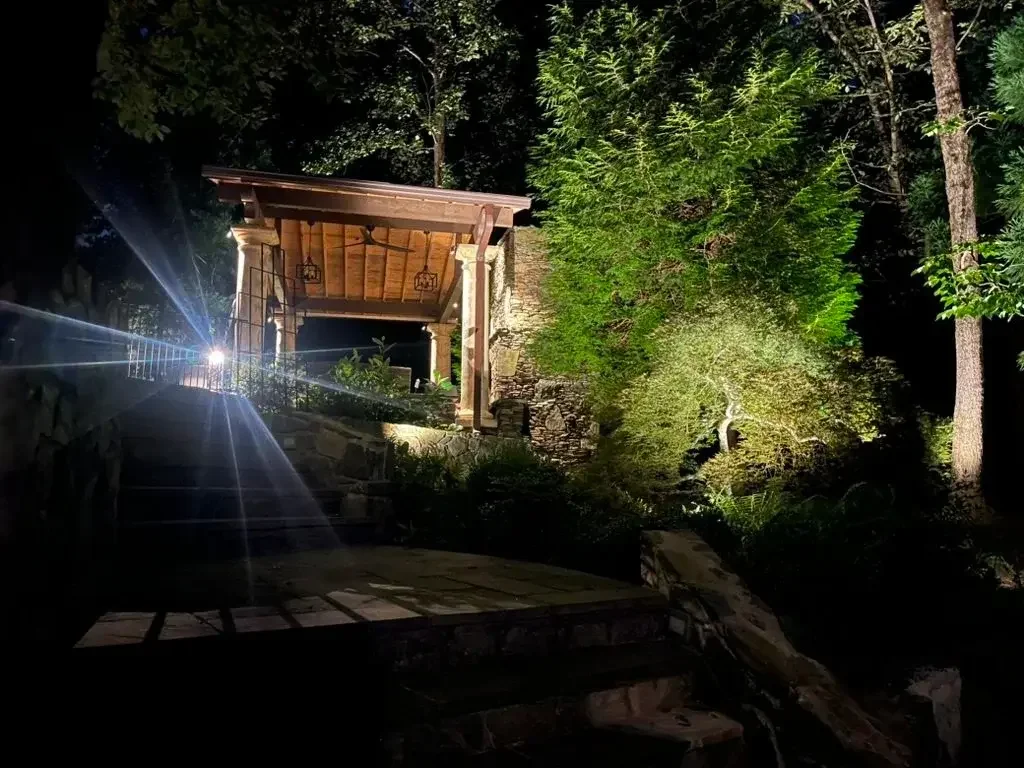
The pavilion and surrounding landscape lit as a cohesive nighttime destination, with bollard lighting providing subtle pathway guidance and sculptural presence.
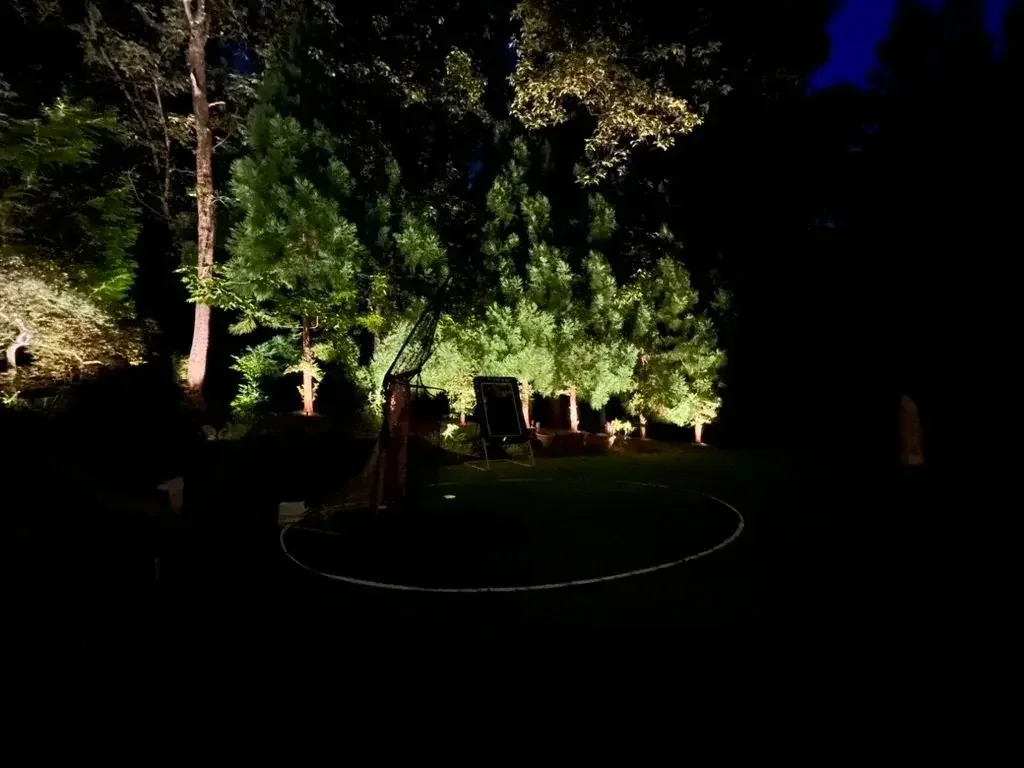
Evergreen trees lit with layered uplighting to add depth and dimension, extending nighttime views from the home and overlooking the sport court.
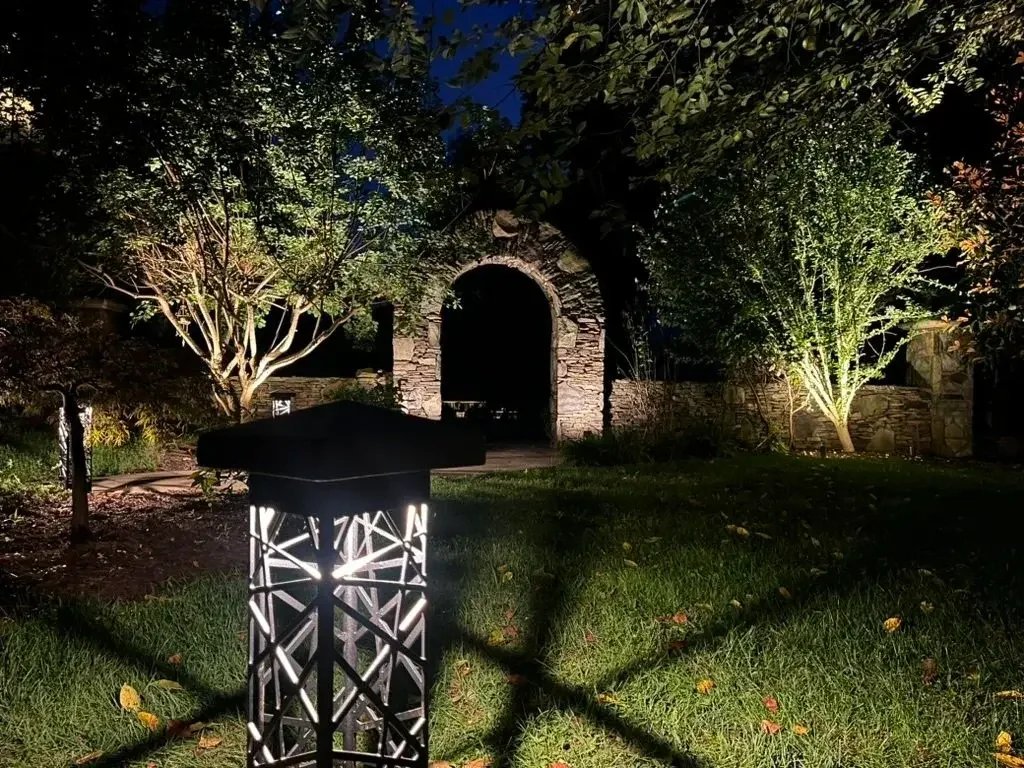
Bollard lighting, tree uplighting, and architectural highlights work together to define pathways and emphasize key backyard features.
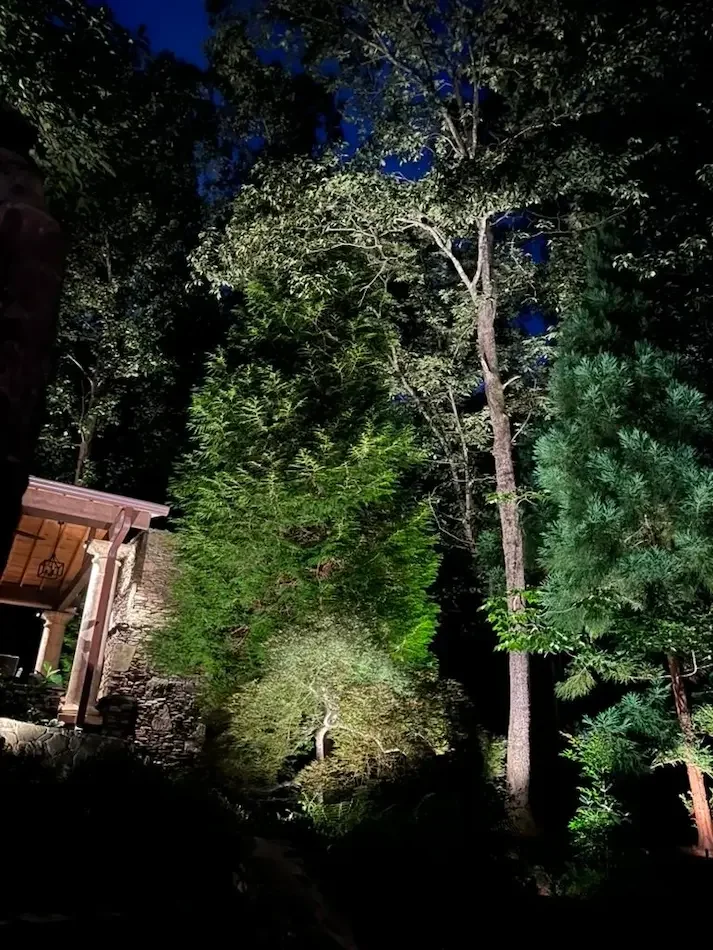
Outer foliage and trunk uplighting work together to create depth, scale, and long-distance visibility across the property.
Fixture Selection and System Scale
The final system includes more than 100 fixtures across the property and over 1,000 feet of low-voltage wiring. To manage voltage drop and long-term reliability, the system was divided into multiple zones, each designed around electrical best practices.
For the core of the system—the “meat and potatoes” fixtures—we selected solid brass drop-in fixtures. A mix of MR16, MR11, MR8, and G4 wash and flood lamps allowed us to tailor beam spreads and output precisely to each application.
The front façade features permanent architectural lighting with color capability, while decorative elements like bollards provide contrast and visual interest. Even the consumer-grade fixtures we removed from the front yard were thoughtfully repurposed, hidden at the base of a retaining wall to uplight distant holly trees visible from the pool deck.
Nothing was wasted. Everything was intentional.
Control, Color, and Family Experience
For color and control, we evaluated multiple systems. Ultimately, the homeowners chose a user-friendly system with remote management:
“Game Day” scenes for family events
Color options for birthdays or celebrations
For color and control, we evaluated multiple systems. Ultimately, the homeowners chose a user-friendly system with remote management.
Features like “Game Day” scenes resonated with the family—particularly the middle-school boys—while the ability to change the home’s color for birthdays or celebrations appealed to everyone. The system balances everyday elegance with fun, making outdoor lighting part of the family experience.
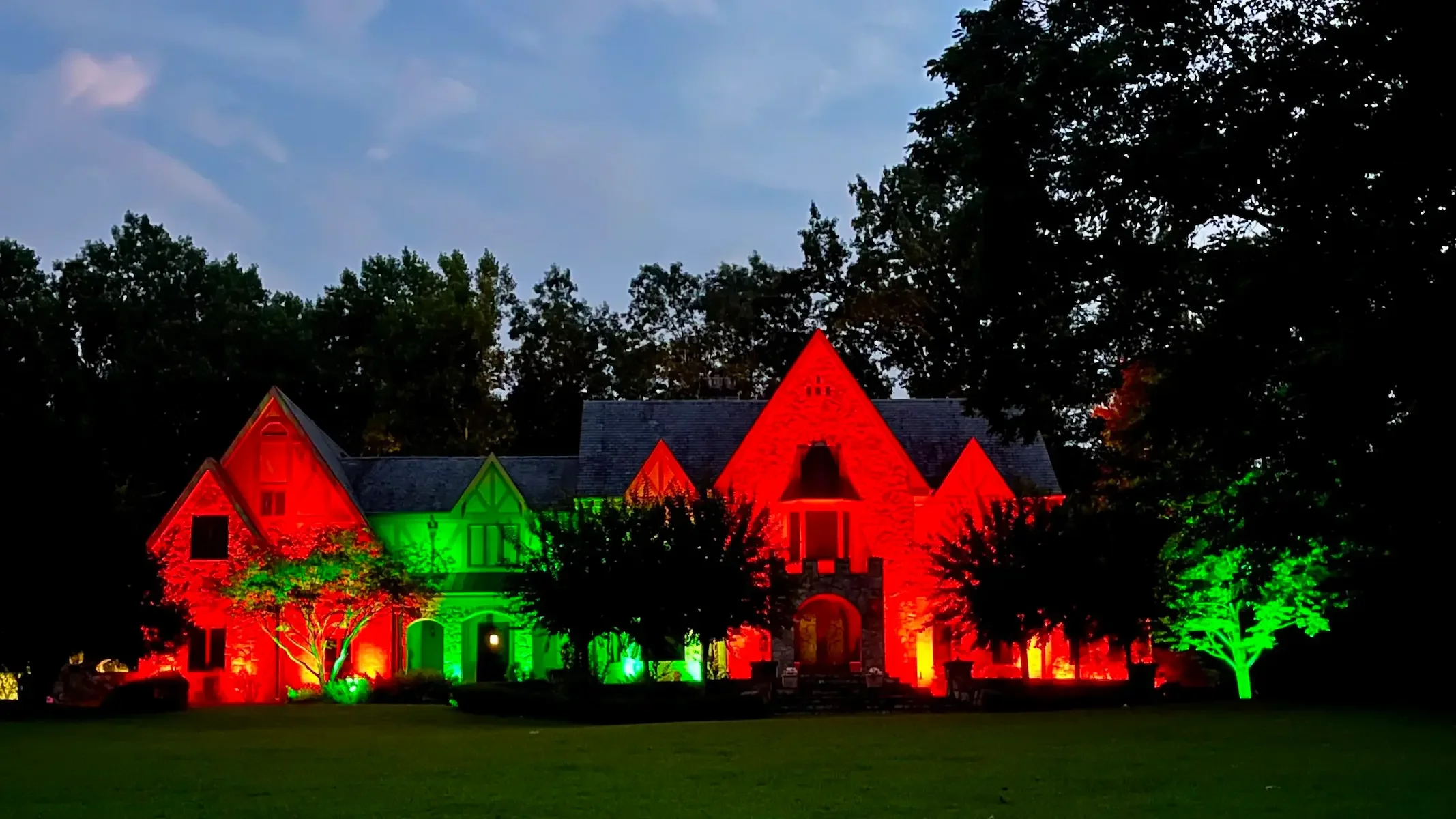
Seasonal color scenes allow the home’s façade to shift for holidays like Christmas, without compromising the architectural lighting used the rest of the year.
Designing for What Comes Next
One of the most important aspects of this project is what hasn’t been installed yet.
The design anticipates future expansion:
Stone columns along the perimeter fence
Dramatic entrance pillars at the driveway
Additional clusters of tall trees
Wire routing, load capacity, and zoning were all planned to allow seamless upgrades. This ensures the system evolves with the property. When the homeowners are ready, the infrastructure is already there.
The Result
What began as a simple consultation became a fully reimagined estate lighting system that:
Restores architectural presence
Supports family life and entertaining
Provides year-round enjoyment
Is built for longevity and future flexibility
Just as importantly, it’s a system built for longevity. It doesn’t force decisions today that limit possibilities tomorrow.
That’s what thoughtful lighting design should do. It should respect the property, serve the people who live there, and anticipate what comes next—quietly, intentionally, and beautifully.
Ready to Transform Your Northern Virginia Estate?
Whether your property is in Great Falls, Loudoun County, or Fairfax County, Loudoun Lighting can design an estate-scale outdoor lighting system that combines beauty, functionality, and long-term reliability.
Contact us today to schedule your consultation and see how custom outdoor lighting can elevate your home.
FAQs
How does outdoor lighting highlight your home?
Outdoor lighting can accentuate architectural features, create depth, and enhance curb appeal. For example, uplighting stone façades, downlighting columns, or spotlighting entryways emphasizes a home’s design while providing functional illumination. Thoughtful placement also avoids harsh shadows and ensures a balanced, inviting appearance, day or night.
What makes estate-scale outdoor lighting different from standard landscape lighting?
Estate-scale lighting requires careful planning, zoning, and fixture selection to highlight architectural features, illuminate large properties, and provide functional safety. Unlike standard landscape lighting, it balances visual appeal, usability, and long-term reliability for large Northern Virginia homes.
Can existing fixtures and wiring be reused in an outdoor lighting redesign?
Sometimes, yes. Transformers or select fixtures may be salvageable. However, in older systems, many components may be deteriorated or incorrectly installed. We always recommend replacing compromised fixtures to ensure safety, reliability, and professional-quality results.
How long does it take to install a full estate lighting system in Great Falls?
Installation time varies based on property size, complexity, and fixture type. For a property similar to the four-acre Great Falls estate in our case study, the process typically spans several weeks, ensuring attention to detail and professional-quality results.