
A Thoughtful Approach to Lighting Colonial Homes
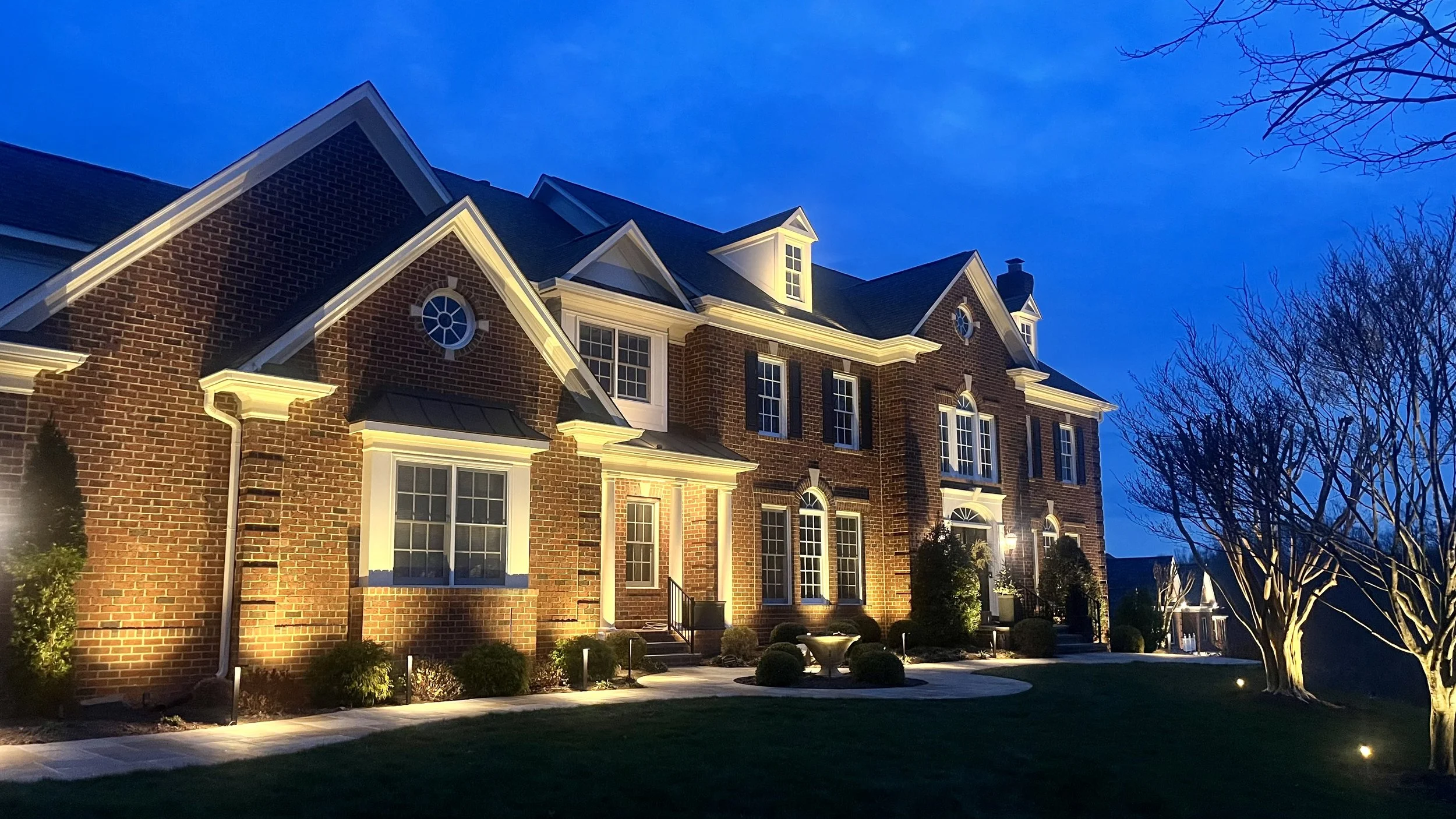
Colonial homes are among the most recognizable architectural styles in Northern Virginia, especially throughout Loudoun County and Fairfax County. They’re defined by symmetry, proportion, and discipline—centered entryways, evenly spaced windows, and a façade that feels balanced from every angle.
Because of that, lighting a Colonial home requires restraint.
Not less lighting—just better decisions.
Too often, we see outdoor lighting installation projects that treat Colonial homes the same way you might treat a more contemporary property: bold contrasts, aggressive uplighting, or inconsistent beam spreads.
The result is a home that feels over-lit and slightly out of character.
The goal should be the opposite.
A well-lit designed landscape lighting system for a Colonial home should feel calm, intentional, and quietly elevated at night—almost as if it always looked that way.
What’s the biggest mistake people make when lighting a Colonial home?
Overdoing it.
Colonial architecture already gives you structure and rhythm. When lighting competes with that—rather than reinforcing it—you lose the very thing that makes the home attractive in the first place.
Start With Discipline, Not Fixtures
Before we ever talk about fixtures, we talk about principles.
For Colonial homes, that usually means:
Warm white outdoor lighting (2700K–3000K)
Symmetry wherever possible
Consistent beam spreads
Hidden light sources (no visible glare)
Restraint in brightness and placement
These aren’t arbitrary preferences. They’re guardrails that protect the integrity of the home.
Once those are established, the outdoor lighting design becomes much clearer.
Think in Layers, Not Fixtures
The most successful custom outdoor Colonial lighting systems are built as layered designs. Each layer plays a role, and when they’re all working together, the home feels complete without ever feeling overdone.
1. Structure: Guiding Movement (Path Lighting)
The first layer is about navigation—walkways, driveways, and approaches. It’s about the visual rhythm leading to the front door.
This is where path lighting comes in, but it’s not just about safety. On a Colonial property, path lighting should:
Reinforce symmetry
Create a steady visual rhythm
Guide movement without drawing attention
2. Architecture: Revealing the Home
This layer highlights the home itself—columns, trim, shutters, and rooflines.
These features benefit from controlled, upwards lighting but with architectural lighting, retraint matters most.
You’re not trying to flood the façade. You’re trying to reveal it.
Consistent beam spreads and thoughtful placement allow the home’s structure to read naturally.
👉 Quick Thought Before You Go Further
If you’re looking at your home and thinking,
“Something feels off at night, but I can’t quite explain it,”
…it’s often not the fixtures—it’s the lack of a cohesive lighting design plan.
A short design consultation can usually clarify that quickly.
3. Support: Balancing the Scene
Even with strong architectural lighting, you’ll often have areas that feel too dark or uneven.
A soft, wide wash of light helps:
Smooth transitions
Balance contract
Complete the overall look
It’s subtle, but this is what separates a “good” lighting system from one that feels finished.
4. Depth: Bringing the Landscape to Life
One of the most overlooked opportunities in Colonial lighting design is depth.
Lighting trees from above—what we call moonlighting—introduces a softness that you simply can’t achieve from ground-level fixtures alone. It creates:
Natural-looking illumination
Soft shadows across lawns and garden beds
Dimension without visual clutter
5. Detail: Finishing the Edges
Hardscape lighting—integrated into steps, walls, and terraces—adds a final layer of refinement.
This is where safety and aesthetics meet. Hardscape lighting provides:
Safety without harsh brightness
Subtle definition of outdoor spaces
A clean, high-end finish
It’s subtle, but it matters.
6. Entry: Anchoring the Composition
Finally, the front entry.
On a Colonial home, the front door is the focal point.
Lighting here should be balanced, symmetrical, warm and welcoming.
Not bright. Not dramatic. Just clear and intentional.
How It All Works Together
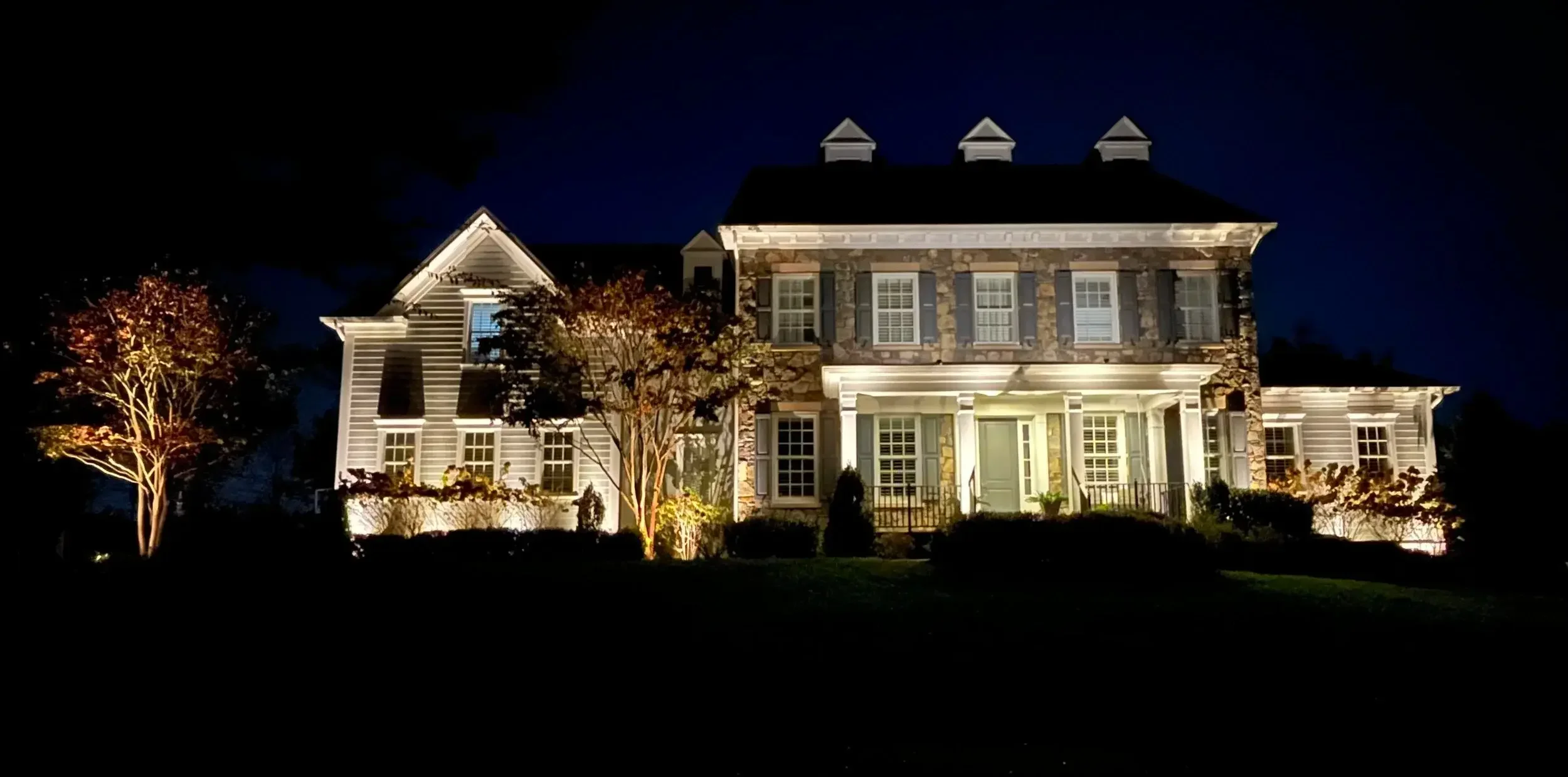
When these layers are designed as a system—not as individual fixtures—the result feels effortless.
Path lighting establishes order
Architectural lighting reveals structure
Support lighting smooths transitions'
Tree lighting adds depth
Hardscape lighting defines space
Entry lighting anchors the composition.
None of it should stand out on its own.
But together, it changes everything.
Outdoor Lighting for Colonial Homes in Loudoun & Fairfax County
Lighting a Colonial home isn’t about making a statement.
It’s about respecting what’s already there.
When done well, your outdoor lighting system doesn’t feel like an addition—it feels like a natural extension of your home and landscape.
And that’s the goal.
Schedule a Colonial Home Lighting Consultation
If you have a Colonial home in Loudoun County or Fairfax County and want lighting that feels intentional—not overdone—we’d be happy to walk your property and talk through what’s possible.
No pressure. Just clarity.
FAQs
What’s the biggest mistake when lighting a Colonial home?
Over-lighting is the most common mistake. Colonial homes rely on symmetry and structure, and excessive or inconsistent lighting disrupts that balance.
Do I need a lot of fixtures for outdoor lighting?
No, a well-designed system focuses on layering and purpose rather than quantity. Each fixture should contribute to a cohesive overall design. Lighting a Colonial home effectively isn’t about adding more lights. It’s about making sure each light has a purpose and contributes to a cohesive whole.
Is tree lighting necessary for a Colonial home?
It’s not necessary, but highly impactful. Tree lighting adds depth, softness, and dimension that elevate the entire property. It’s one of the easiest ways to elevate a property from “well-lit” to “thoughtfully designed.”
Can outdoor lighting be installed in phases?
Yes. Many of our clients start with a core set of layers and expand over time. The key is having a plan from the beginning so each addition builds on the last rather than feeling pieced together.
What color temperature is best for Colonial home lighting?
Warm white lighting (typically 2700K–3000K) is ideal. It complements traditional architecture and creates a natural, welcoming appearance.
How much does outdoor lighting cost in Loudoun County or Fairfax County?
Costs vary depending on property size, fixture quality, and design complexity. Most professionally designed systems are customized, so a consultation is the best way to get an accurate estimate.