
Detective Diagnostics: Why a “Simple” Lighting Issue Isn’t So Simple
Service calls usually feel less like routine maintenance and more like detective work—piecing together what changed, who touched what, and how a well-built system quietly unraveled.
This was one of those cases.
A Leesburg homeowner contacted us because an entire side of their landscape lighting system had gone dark. The system was only three years old and had been installed by a reputable local firm. At first glance, the installation looked solid: quality fixtures and transformer from Sterling Lighting, proper crimp connections, and a thoughtful layout for both the lighting design as well as future expandability. This was not a bargain-basement system.
But as we began our diagnostic process, two root causes quickly emerged—both instructional for any homeowner with low-voltage lighting.
Clue #1: Shallow Wire Burial and Its Impact on Landscape Lighting
Much of the cable had been buried only 1–2 inches below grade. That may seem minor, but it’s a critical failure point. Shallow burial exposes wiring to:
Lawn equipment & edging
Foot traffic
Frost heave
Soil movement
Over time, insulation breaks down and conductors are damaged—often invisibly.
The result? Intermittent outages, voltage instability, and eventual system failure. Even the best fixtures cannot overcome compromised wiring.
Clue #2: Transformer Relocation Mistakes That Damage Fixtures
After the original lighting installation, the homeowner added a standby generator. During that project, a site prep crew relocated the landscape lighting transformer to make room for new switchgear.
Relocating a transformer is not inherently a problem—but how it’s done matters. In the image below to the left, you can see the transformer’s conduit is dislodged giving us a clue something was amiss. And when we opened the transformer cover and only found 1 lead wire this was concerning as well. A large lighting system almost always has multiple wire runs.
Originally, the system had five separate cable runs, each almost certainly assigned to different voltage taps to manage voltage drop based on distance and load. Those five runs lead wires were not long enough to reach the new location of the transformer.
The solution chosen on site? A single extension cable was run from the transformer, all five original runs were consolidated into that one lead using wire nuts and electrical tape, as seen in the photo below on the right. The combined lead was placed on the highest voltage tap (22 volts).
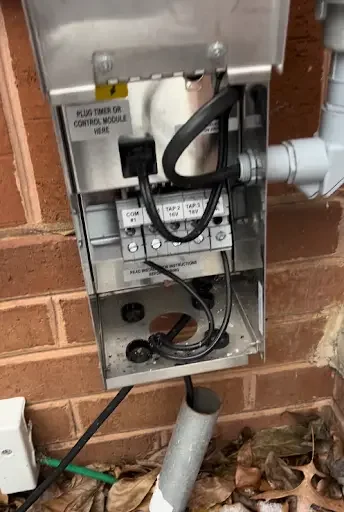
The transformer conduit was dislodged during the generator installation, causing wiring consolidation errors.
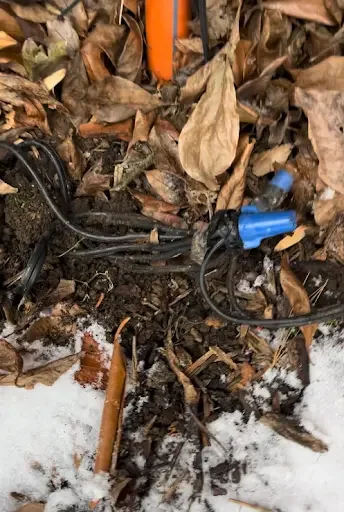
All five original cable runs were improperly combined into a single lead, creating over-voltage and causing fixture damage.
This is where the real damage occurred. The fixtures nearest the transformer no longer work, presumably burned up by the 22v of power they were receiving. Fixtures 100+ feet away from the transformer and on wire runs with many other fixtures collectively experienced sufficient voltage drop that the 22v was within the operating range for the fixtures and they survived.
This is where the real damage occurred. The fixtures nearest the transformer no longer work, presumably burned up by the 22v of power they were receiving. Fixtures 100+ feet away from the transformer and on wire runs with many other fixtures collectively experienced sufficient voltage drop that the 22v was within the operating range for the fixtures and they survived.
Why Voltage Taps Matter for Low-Voltage Landscape Lighting
Low-voltage transformers have multiple taps to prevent fixture damage. They allow designers to compensate for voltage drop over distance so fixtures operate within their intended range—typically 10–15 volts for most LED landscape fixtures and lamps.
Consolidating multiple runs onto a single high-voltage tap does not “add capacity.” It does the opposite: it overpowers fixtures, shortens LED life, and often causes irreversible damage. In this case, several fixtures were pushed well beyond their rated operating range and failed prematurely.
Because this was an installation error—not a product defect—the fixtures are unlikely to be covered under warranty.
The Bigger Lesson: Treat Your Outdoor Lighting as a System
This case is a reminder that landscape lighting is not just fixtures and wire—it’s a designed electrical system. Changes made by other trades, even well-intentioned ones, can undermine that system if the original design principles aren’t preserved.
Any time a transformer is moved, wiring is extended, or loads are altered, the system may need to be rebalanced and re-engineered.
When to Call a Professional for Landscape Lighting Diagnostics
If your lighting system has been modified, expanded, or serviced by another trade—or if fixtures are failing earlier than expected—it’s time for a professional evaluation.
👉 Schedule a professional system diagnostic with Loudoun Lighting today. We identify root causes, document deficiencies, and recommend fixes that protect your investment long-term.
FAQs
Why didn’t the fixture warranty cover the failure?
Most manufacturers specify a strict operating voltage range. When fixtures are consistently overpowered—such as running a 22V tap into fixtures rated for 10–15V—failures are considered misuse, not manufacturing defects.
How deep should landscape lighting wire be buried?
While low-voltage systems don’t require the same depth as line voltage, shallow burial (1–2 inches) almost guarantees damage. Proper depth and routing are essential for durability and serviceability. The National Electic Code (NEC) calls for 6in burial of direct burial low voltage outdoor lighting wire.
Should electricians work on landscape lighting systems?
Electricians are highly skilled, but landscape lighting is a specialized discipline. Any transformer relocation or wiring change should involve a lighting professional to preserve voltage balance and system integrity. If the electrician is proficient in low voltage systems and the NEC requirements, manufacturer recommendations, etc then they may certainly do a good job with repairs or maintaining the functioning of an existing system. However, when it comes to the aesthetics and functionality of lighting design, Loudoun Lighting always recommends involving a professional lighting designer to help you achieve your goals.