
McLean Landscape Lighting: A Lighting Design That Evolved With the Property
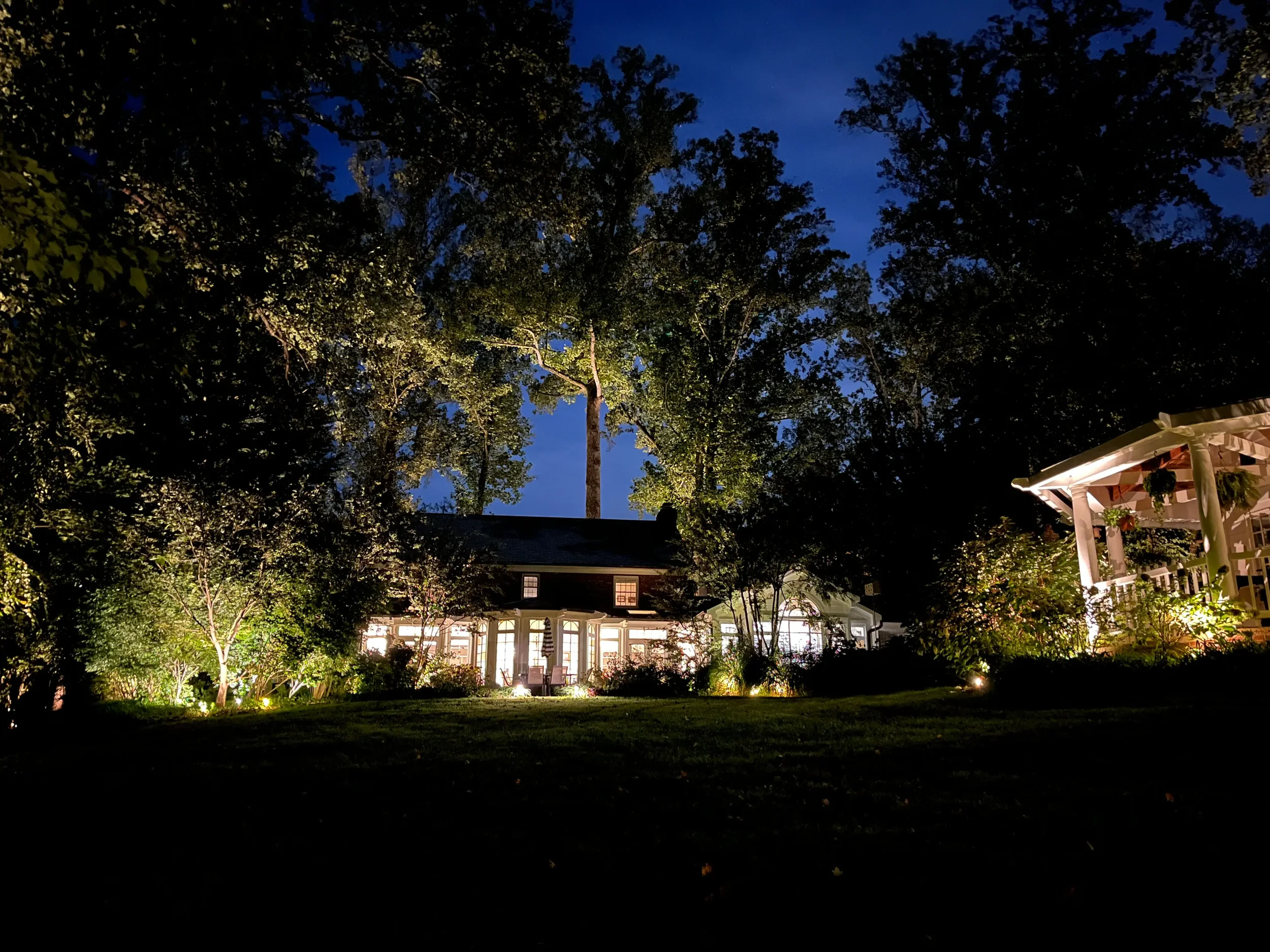
In the spring of 2025, a new client reached out to us from McLean. He and his family had recently returned to the United States following the completion of his military career and purchased a classic 1972 red-brick Colonial situated on just over an acre.
The property is long and narrow, with considerable depth and several distinct outdoor zones. Initially, the client contacted us to discuss lighting the front of the home.
Starting With the Fundamentals of Professional Landscape Lighting
Our first step was education. We explained the differences between retail-grade and professional-grade landscape lighting, including fixture materials, construction quality, weather resistance, serviceability, and expected longevity. We also discussed the advantages and tradeoffs of integrated LED fixtures versus fixtures that accept replaceable, drop-in lamps.
Just as importantly, we explained that professional lighting design involves much more than selecting attractive fixtures. The lamp, lumen output, color temperature, beam angle, and photometric performance all affect how the light reaches and interacts with a surface.
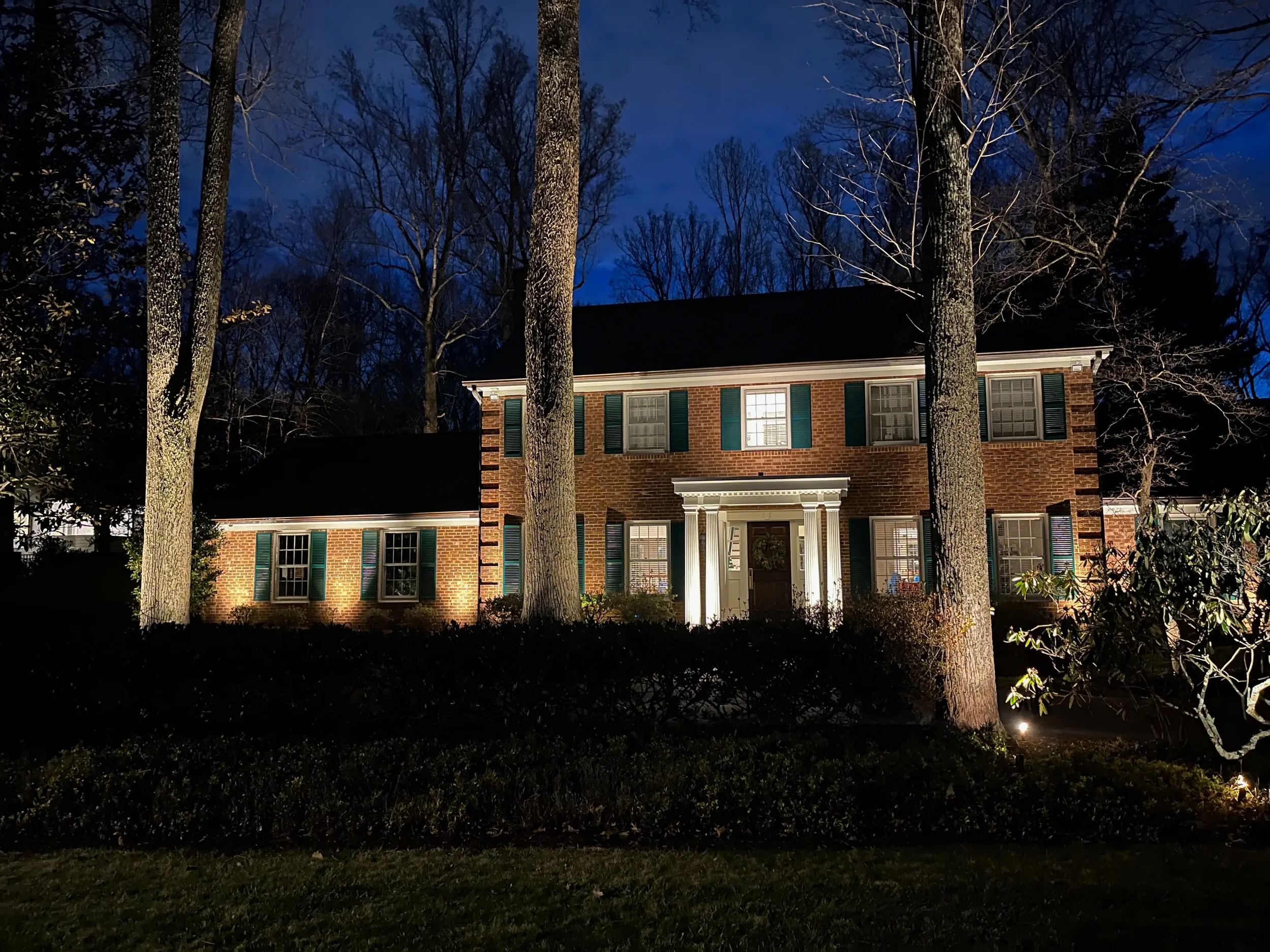
A narrow beam might accentuate a column or architectural detail, while a wider beam may be better suited to washing a broad section of façade. The correct specification depends on the height, width, color, texture, and reflectivity of the surface being illuminated, as well as the viewing angles from which it will be experienced.
With that foundation established, we introduced the client to classic warm uplighting on the home’s façade, complemented by layered lighting in selected trees and shrubs.
The home also has a horseshoe-shaped, pull-through driveway lined with mature trees. This presented an opportunity to create depth when viewing the property from the street: the illuminated architecture would form the primary focal point, while lighting in the trees closer to the road would create another visual layer.
The client ultimately decided to start small. We illuminated the façade and two trees positioned at opposite ends of the house, visually bookending the architecture.
Within a few weeks of completing the first phase, the client invited us back to walk the backyard.
Expanding the Landscape Lighting Into the Backyard
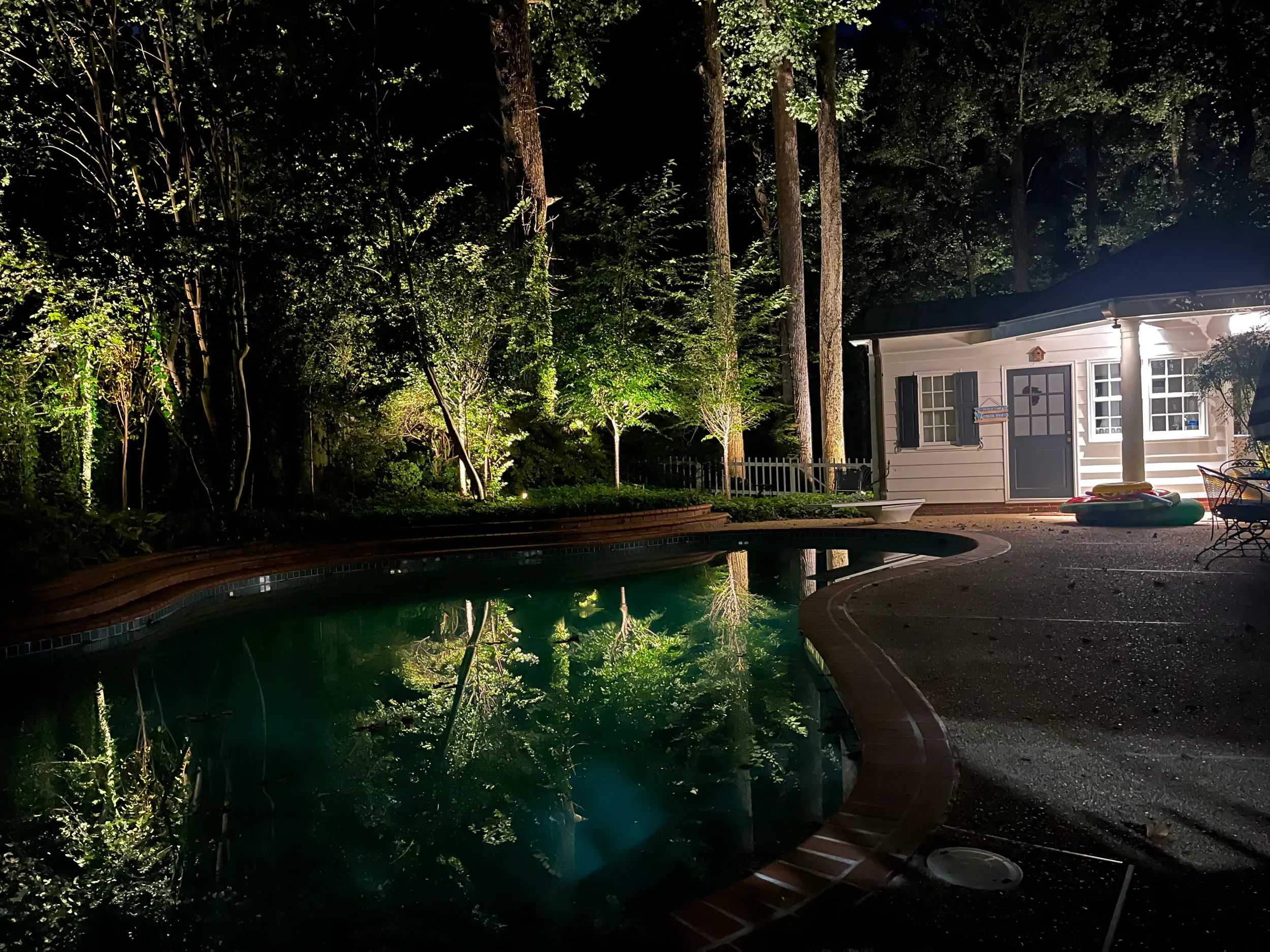
The rear of the property includes a pool and pool house, along with a large open lawn immediately beyond the patio. That lawn is approximately 120 feet square and bordered by shrubs and mature trees. Farther back—several hundred feet from the house—was a heavily overgrown wooded area containing trees approaching 80 feet in height.
We began by discussing how lighting could define the perimeter of the main lawn. By selectively illuminating trees and shrubs around its edges, we could make the space feel intentional and visually contained without flooding the lawn with light.
Some retail-grade lighting had also been left behind by the previous owner. Rather than removing everything and starting over, the client asked us to restore as much of that system as practical and then supplement it with professional-grade lighting. We accommodated that request and developed a proposal for the backyard.
When the client decided to move forward, he also asked us to add the front-yard trees that had been included in our original design for the front of the property. Within just a couple of months, what began as a modest façade-lighting project had expanded to include much of the backyard, along with the full front-yard design we had initially proposed.
Over the following months, the property continued to change—and the lighting changed with it.
Adding Pool Lighting to the Landscape
The client brought us back to add lighting around the pool perimeter. We later illuminated a hedge separating his property from the neighboring home. As he worked with his landscaper to add laurel hedges and a variety of ornamental trees throughout the property, we returned to incorporate those new landscape elements into the lighting design.
Creating a Distinctive Entrance With a Landscape Lighting Bollard
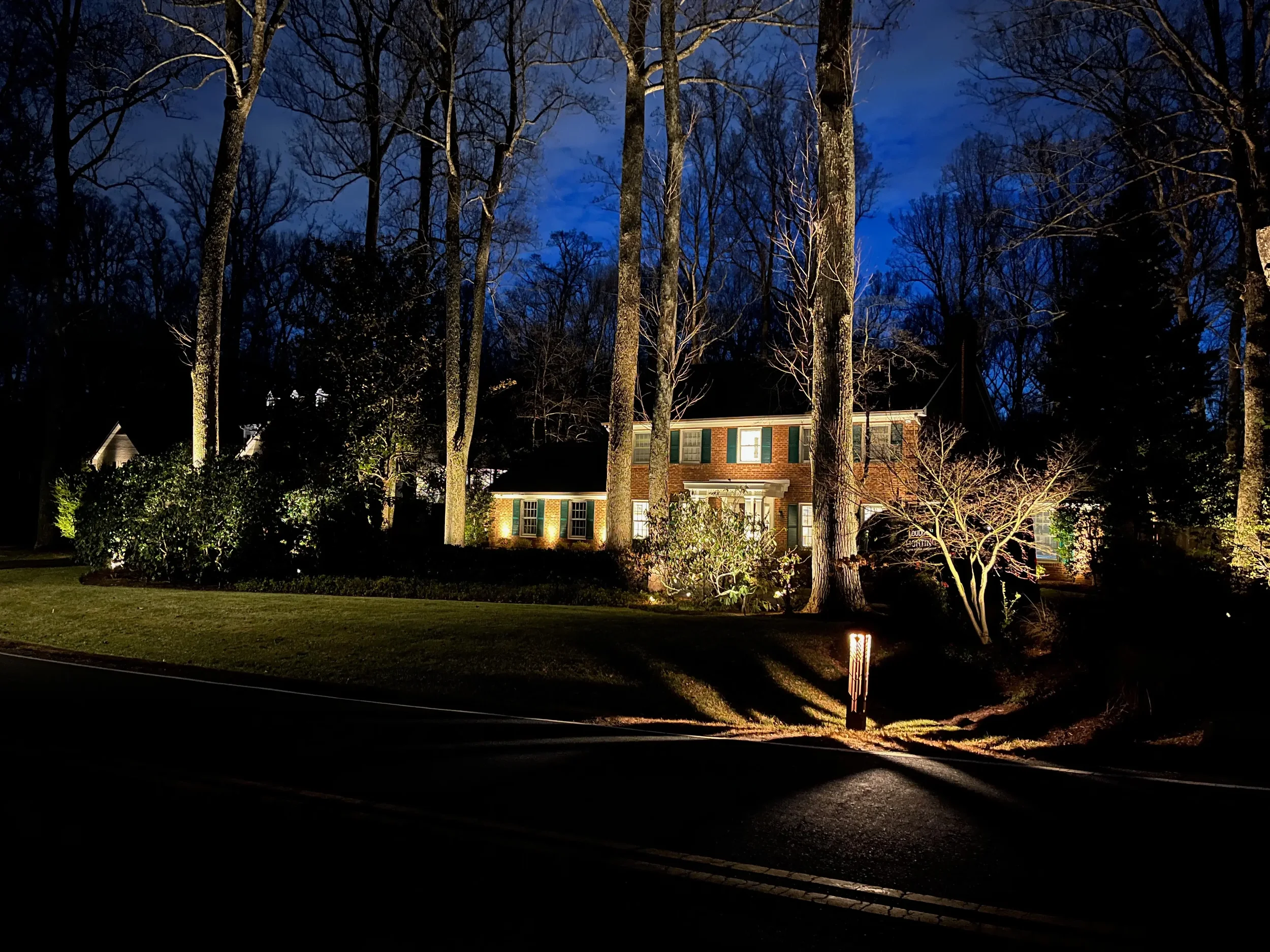
We also helped solve a practical problem at the entrance to the property. Because the driveway sits along a bend and slight rise in the road, arriving guests often could not see the entrance until they had already passed it. Traditional address lighting alone would not necessarily solve the problem because the driveway needed a distinctive, easily described visual marker.
Our solution was a 42-inch bollard from Tailored Lights. In addition to creating an attractive focal point at the entrance, the bollard gave the client a simple landmark to share with visitors: look for the illuminated bollard at the driveway. It differentiated the property without relying on excessive brightness or a purely utilitarian marker.
Then, one of the most significant phases came when the landscapers cleared the underbrush from the wooded area at the far end of the backyard. What had previously been an overgrown bramble was transformed into an open, park-like setting with grass beneath a canopy of exceptionally tall trees.
Designing the Landscape From Inside the Home
As the client considered lighting this area, we did not evaluate it solely from the backyard. We also spent time inside the pool house, which doubles as a guest house. The guest bedroom has a bay window overlooking the newly opened wooded area, creating an important interior vantage point that needed to be considered as part of the design.
We learned that the client’s father stays in this room when he visits. That gave the project another personal dimension. We wanted the lighting beyond the window to create a few carefully composed focal points—a peaceful, aesthetically pleasing nighttime view that could be enjoyed from inside the guest room.
Rather than attempting to illuminate the entire wooded area uniformly, we considered which trees would create the most interesting composition when viewed through the bay window. This allowed us to extend the experience of the property into the guest house and transform what could otherwise have appeared as a dark window into a framed view of the landscape.
Using Well Lights to Preserve the Natural Character of the Landscape
Once the landscaping work was complete, we installed in-ground well lights at the base of the selected trees. The client has young children and wanted to minimize trip hazards. He also wanted to avoid creating obstacles for the landscaping crew. Just as importantly, he did not want visible fixtures disrupting the clean, natural character of the newly opened space.
Well lights were an excellent solution. They allowed us to illuminate the trees while keeping the fixtures discreet and the ground plane largely unobstructed. They also created the depth and focal points we had envisioned from the guest-bedroom window.
Designing the Lighting Around How the Property Is Experienced
An important part of each phase was walking the property with the client after dark. We wanted to understand how he experienced the space—what he particularly enjoyed, which illuminated elements stood out to him, and which areas still felt too dark. Those nighttime conversations helped us incorporate his perception of the property into each successive design decision.
That was especially meaningful in this case because the property serves as a genuine place of respite for him. He now works in government contracting and often spends his days inside a SCIF, largely separated from windows and natural light. Coming home in the evening to a peaceful, warmly illuminated landscape—one that now feels more like a private park than a collection of disconnected outdoor areas—provides a welcome contrast.
Planning the Next Phase of the Landscape Lighting Design
The photographs accompanying this story show the project as it exists today, but they do not show the end of the story. We recently met with the client to discuss the next phase of enhancements.
As he has experienced the lighting and learned more about what it can accomplish, he has begun to appreciate the value of additional layers. The next phase may include smaller fixtures for smaller shrubs and plantings, high-hat and garden lights to introduce different directions of light within the landscape beds, and additional accent lighting to create greater depth and visual interest.
We are also considering moonlighting in several areas. From a design standpoint, carefully placed moonlights can reveal the beauty and scale of the property while producing a natural effect from above. They can also address a practical request from the client: providing additional illumination when the family hosts gatherings in selected areas of the grassy lawn.
A second gathering space has been created in the wooded area at the back of the property, where the client has leveled a portion of the ground for a fire pit, and other activities. Moonlighting there could make the area more functional when needed while preserving its natural, park-like character. He wants the flexibility to turn the moonlights off independent from the rest of the system. We assured him we can make that happen.
A Landscape Lighting Design That Evolves With the Property
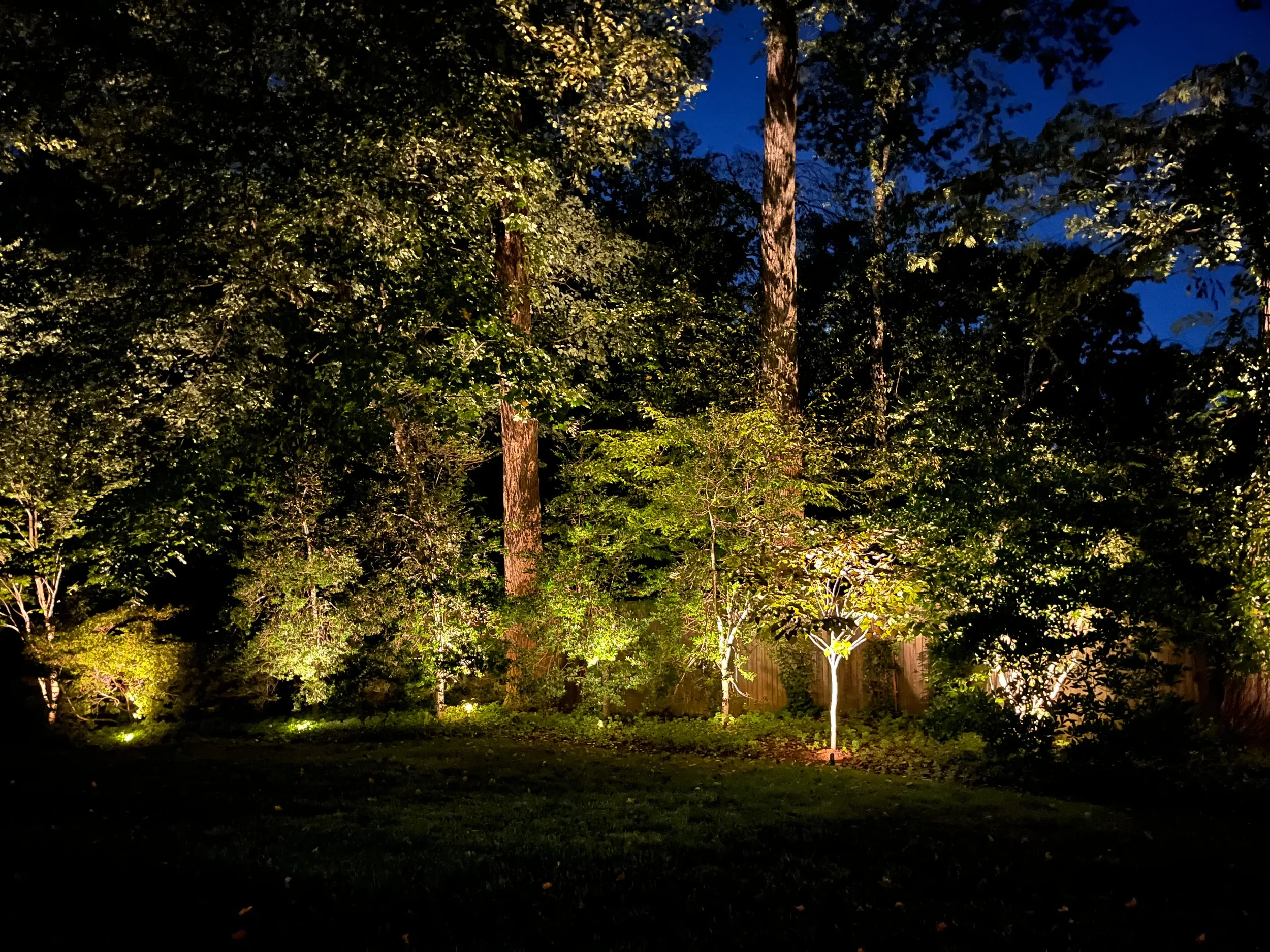
This project demonstrates that a thoughtful outdoor-lighting plan does not have to be completed all at once. Lighting can be phased, experienced, and refined over time. It can also adapt as the family discovers new ways to use the property.
Over the past 18 months, this client has transformed the landscape by removing old undergrowth, opening the wooded area, and planting new hedges and ornamental trees. Our lighting design has grown alongside those changes, responding to both the evolving landscape and the family’s evolving use of it.
What started with a few fixtures on the front of the house has become a layered lighting design extending across more than an acre—combining beauty, function, safety, and a stronger sense of arrival. Yet the project is not finished.
The landscape will continue to grow, the family will continue to find new ways to enjoy it, and the lighting will continue to evolve with them. There is more to come.
Considering landscape lighting for your McLean property?
A thoughtful lighting design can be developed in phases, allowing you to prioritize the areas that matter most and expand the system as your property evolves.
Explore our landscape lighting design services →
Frequently Asked Questions
What does professional landscape lighting include?
Professional landscape lighting involves more than selecting attractive fixtures. A lighting design considers fixture construction, lamp or LED performance, lumen output, color temperature, beam angle, photometric performance, mounting location, viewing angles, and the characteristics of the surfaces and landscape elements being illuminated.
Can landscape lighting be installed in phases?
Yes. Landscape lighting does not have to be completed throughout a property at one time. A project can begin with key architectural or landscape features and expand as the property, landscaping, and family's use of the outdoor spaces evolve.
How do you light a pool area?
Pool area lighting should be considered as part of the surrounding landscape rather than as an isolated feature. Lighting around the pool perimeter can help define the space while layered lighting in nearby trees, shrubs, architecture, and other landscape elements creates depth and visual continuity.
What is the difference between landscape lighting and architectural lighting?
Landscape lighting focuses primarily on outdoor landscape elements such as trees, shrubs, pathways, lawn areas, and garden beds. Architectural lighting emphasizes structures and architectural details such as façades, columns, entries, and other features of a home. A thoughtful outdoor lighting design often combines both.
What are well lights used for in landscape lighting?
Well lights are installed below or near ground level and can illuminate trees, architectural elements, and other features while keeping the fixture itself relatively discreet. They can be particularly useful in areas where visible fixtures or above-ground obstacles would interfere with the landscape.
What is moonlighting in landscape lighting?
Moonlighting is a technique that places fixtures high in trees or other elevated locations to cast light downward. When carefully positioned, it can create a natural-looking effect while providing subtle illumination across lawns, gathering areas, and other portions of the landscape.